What is the name of the scale we use to measure hurricanes?
We Need a Better Manner to Measure Hurricanes
The current category system doesn't give a clear indication of how much damage a storm can inflict.
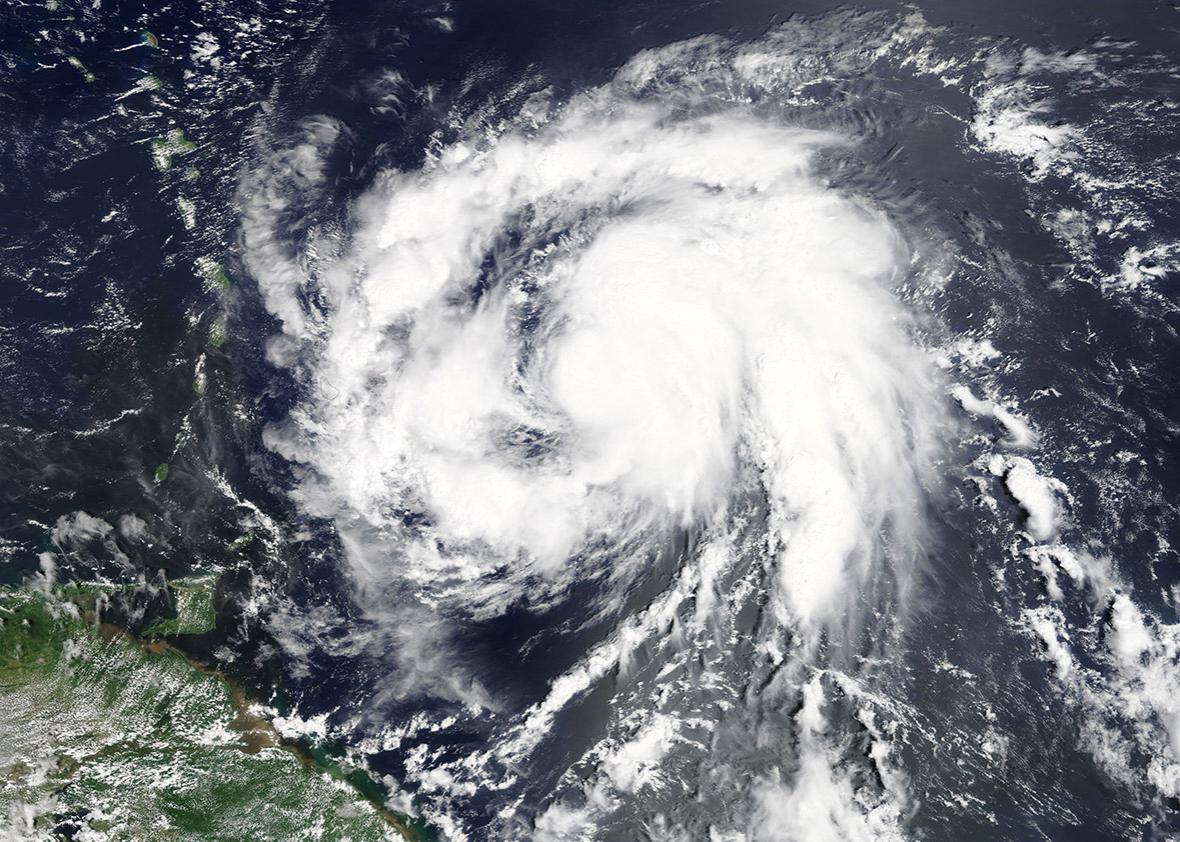
NASA/Reuters
When Hurricane Harvey churned into Texas last calendar month, it fabricated landfall as a Category 4 storm, meaning its sustained wind speed was between 130 and 156 miles per hour. The categorization is determined via the well-known Saffir-Simpson Hurricane Wind Scale, developed in 1971. Category 4 implies "catastrophic damage will occur" as winds severely damage houses, power poles snap, and trees uproot.
The storm did crusade catastrophic damage, but information technology wasn't thanks to its winds. Harvey apace weakened on the declension and was speedily downgraded to a tropical storm, booting it down and off the hurricane scale. Its malice came from spinning in place while information technology dumped several feet of rain. It devastated Houston by water instead of speed. Damages are estimated to exist up to $180 billion, rivaling 2005's Hurricane Katrina for the costliest natural disaster in U.S. history.
In this instance, the Saffir-Simpson category ranking did not accurately capture the storm'due south potential for destruction. Neither did it piece of work for Hurricane Sandy in 2012, which simply ever reached a Category ii rating, and in fact was unranked when it made landfall in the Northeastern U.Southward. Ane of the reason's Harvey was so destructive is because information technology lingered for and so long—but the potential durability of a tempest doesn't factor into the Saffir-Simpson metric. Nonetheless elapsing is i of the main cost drivers of hurricane destruction—especially for lower category storms like 1 or 2, or, in Harvey's example, storms not on the calibration at all. Which is why we need a meliorate way of measuring hurricanes.
"I'm non alone among meteorologists who recollect the time has come to supplant [the Saffir-Simpson calibration]," wrote Dan Satterfield, principal meteorologist for WBOC-TV in Salisbury, Maryland, and a blogger for the American Geophysical Union. While their numbers don't yet make the Weather Channel—which admittedly has provided ever more data to viewers virtually wind speeds, storm surges, and potential for inland flooding—scientists and meteorologists are actively looking for replacements for our category ranking system: some kind of number that volition more than reliably indicate the damage a storm is expected to bring.
I storm metric meteorologists have used for decades is "Accumulated Whirlwind Energy," or ACE. It's proportional to the square of the current of air speed, measured and summed every half-dozen hours. (The square is used, considering, like the kinetic free energy of a auto or cat, energy of motion increases equally the second power of velocity.) Information technology's tabulated religiously every day in hurricane flavour, for each storm, then totaled for the year. Only 1 immediate problem with ACE is that, despite its proper noun, it tin't convey the energy of a storm, because it doesn't accept note of a storm's size.
For hurricanes, size is of paramount importance. Hurricane Katrina surprised inhabitants of the Gulf Coast with its storm surge and destruction in 2005 in part considering it made landfall in Mississippi as only a Category 3, with 125 mph sustained winds. Many in its way expected it to be zero like the monstrous Hurricane Camille of 1969, all the same the 2nd most intense hurricane to ever strike the U.South., which came ashore as a Category v with breathtaking winds of 190 mph.
But Katrina's maximum winds went out to a radius of 30 miles, double that of Camille'due south, then the volume of water it put into move was four times larger. Every bit a upshot, Katrina's storm surge was higher than Camille's all across the declension, and economic losses fourteen times greater.
Sandy, busting Asbury Park's Madame Marie and a great deal else, was the physically largest storm to ever hit the U.S., with a wind field 1,100 miles beyond. It acquired about $79 billion in amercement.
There are metrics that include storm size to better estimate a storm's total energy, similar IKE (integrated kinetic energy), adult in 2007. Some other is the Hurricane Severity Alphabetize, developed by the private company ImpactWeather (since acquired past StormGeo) in 2006.*
Just the best metric to replace our electric current category arrangement would exist one that can measure out what we virtually demand to know about an impending hurricane—how damaging it will be. And that'southward what the Cyclone Impairment Potential measures—the capacity to cause harm. It includes wind speeds and storm size, merely likewise storm elapsing and how the storm'south current of air field will motion. James Done of the National Center for Atmospheric Enquiry and colleagues at NCAR and in the reinsurance industry developed it. CDP predicted that Harvey would be bad, much worse than did Saffir-Simpson. It ranks storms on a calibration from 0 to 10—Harvey was a 5.2 at landfall, Irma a five.9 when information technology made landfall in the Florida Keys, and Maria a 4.2 upon landfall in Puerto Rico. Katrina was a iv.9, Sandy a iii.0, and Hurricane Andrew of 1992 came in at 2.ix.
One of the more pressing reasons behind our need for a ameliorate metric is the worry that climate change will increase the frequency and intensity of hurricanes in the future. Done'southward CDP work is funded by a global reinsurance broker, Willis Towers Watson—a company he says is specifically interested in climate change considering "they understand it volition impact their bottom line." (This is a reassuring converse to Upton Sinclair's pithy line that "It's hard to get a man to believe something when his salary depends on his not believing it.")
Information technology's hard to know how much a more than authentic prediction could have helped Houston prepare for the damage heading its fashion terminal month. Transitioning from the simple and widely known i–5 scale to a subtler alphabetize congenital on more information might exist catchy for the people who take lived in hurricane zones for years and have their own internal barometers of how to respond. Simply every bit we brace for an uncertain future, meliorate metrics can but help.
*Correction, Sept. 25, 2017:This sentence has been clarified to include that StormGeo caused ImpactWeather in 2012. (Return.)
Source: https://slate.com/technology/2017/09/a-better-metric-for-measuring-hurricanes.html
0 Response to "What is the name of the scale we use to measure hurricanes?"
Post a Comment