You Know a Cell Is Active When ____.
Lesson 5: Prison cell Basics
/en/excel2016/saving-and-sharing-workbooks/content/
Introduction
Whenever you work with Excel, you lot'll enter information—or content—into cells. Cells are the basic building blocks of a worksheet. You lot'll demand to larn the basics of cells and prison cell content to calculate, analyze, and organize data in Excel.
Optional: Download our practice workbook.
Watch the video below to learn more about the nuts of working with cells.
Understanding cells
Every worksheet is made upward of thousands of rectangles, which are called cells. A cell is the intersection of a row and a column—in other words, where a row and column meet.
Columns are identified by letters (A, B, C), while rows are identified past numbers (1, 2, 3). Each jail cell has its ain name—or cell address—based on its column and row. In the instance beneath, the selected cell intersects column C and row 5, then the cell address is C5.
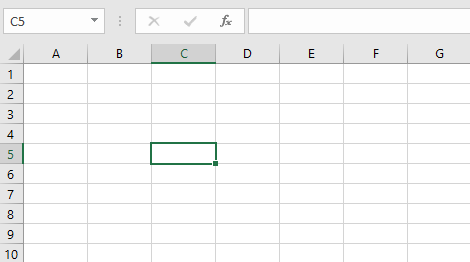
Note that the cell address also appears in the Proper noun box in the top-left corner, and that a jail cell's column and row headings are highlighted when the cell is selected.
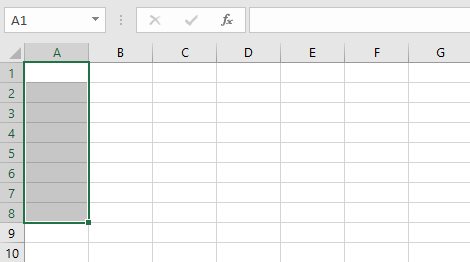
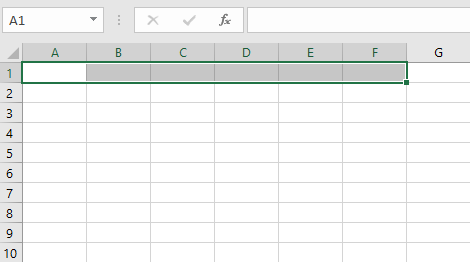
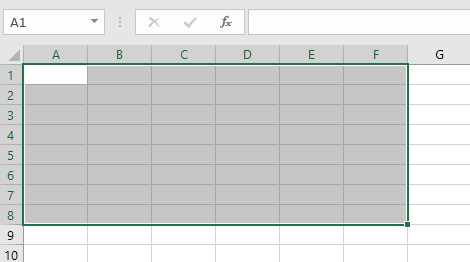
You tin can also select multiple cells at the same time. A group of cells is known as a cell range. Rather than a single jail cell address, you will refer to a prison cell range using the cell addresses of the first and last cells in the cell range, separated by a colon. For example, a cell range that included cells A1, A2, A3, A4, and A5 would exist written equally A1:A5. Accept a wait at the unlike cell ranges beneath:
- Cell range A1:A8
- Jail cell range A1:F1
- Cell range A1:F8
If the columns in your spreadsheet are labeled with numbers instead of messages, y'all'll demand to change the default reference style for Excel. Review our Extra on What are Reference Styles? to learn how.
To select a jail cell:
To input or edit cell content, y'all'll first need to select the cell.
- Click a cell to select it. In our example, we'll select cell D9.
- A edge will appear around the selected cell, and the column heading and row heading will be highlighted. The cell volition remain selected until you lot click some other prison cell in the worksheet.
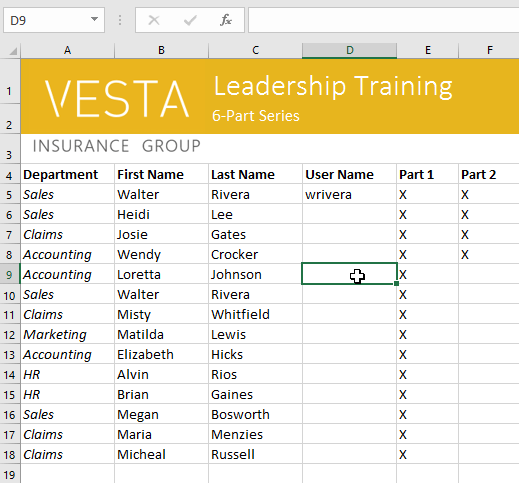
You can as well select cells using the arrow keys on your keyboard.
To select a cell range:
Sometimes you may want to select a larger grouping of cells, or a cell range.
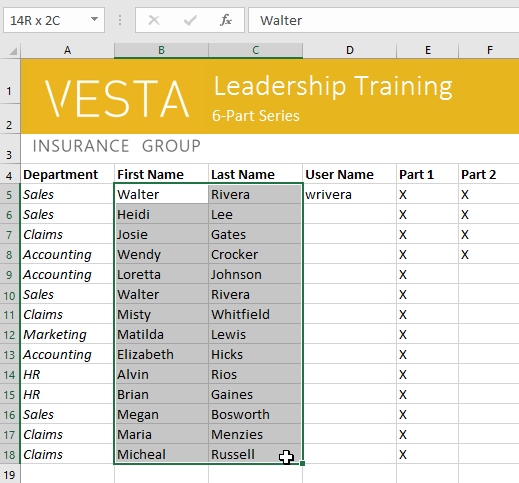
- Click and elevate the mouse until all of the adjoining cells you lot desire to select are highlighted. In our case, we'll select the cell range B5:C18.
- Release the mouse to select the desired cell range. The cells will remain selected until you click another cell in the worksheet.
Cell content
Any information y'all enter into a spreadsheet will exist stored in a cell. Each prison cell can contain different types of content, including text, formatting, formulas, and functions.
- Text: Cells can comprise text, such as letters, numbers, and dates.
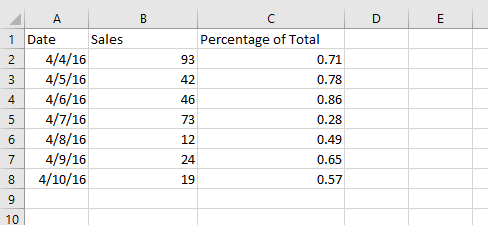
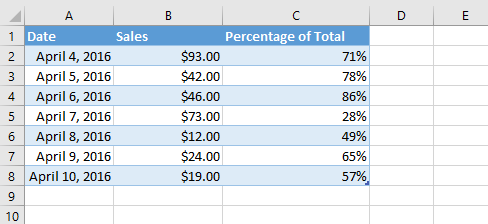
- Formatting attributes: Cells can contain formatting attributes that alter the manner letters, numbers, and dates are displayed. For example, percentages tin can appear every bit 0.15 or fifteen%. You can even change a jail cell's text or background colour.
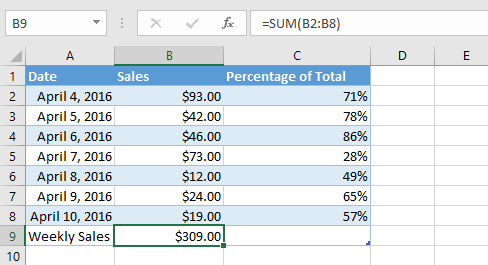
- Formulas and functions: Cells can contain formulas and functions that calculate prison cell values. In our case, SUM(B2:B8) adds the value of each cell in the cell range B2:B8 and displays the full in cell B9.
To insert content:
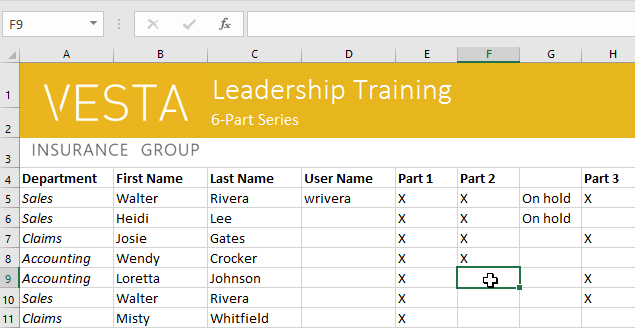
- Click a prison cell to select it. In our example, nosotros'll select cell F9.
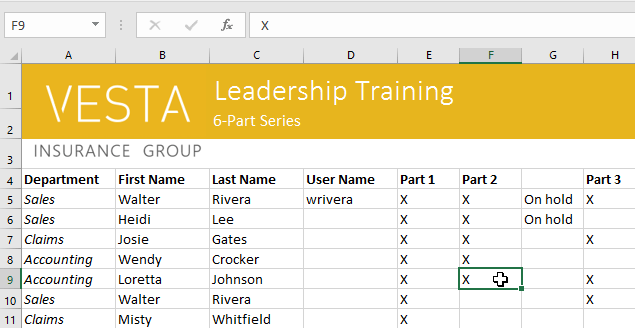
- Blazon something into the selected cell, then press Enter on your keyboard. The content will appear in the jail cell and the formula bar. You tin also input and edit cell content in the formula bar.
To delete (or articulate) cell content:
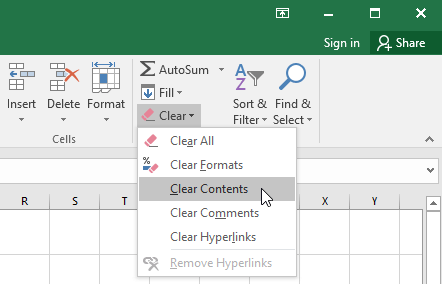
- Select the cell(s) with content you want to delete. In our example, we'll select the jail cell range A10:H10.
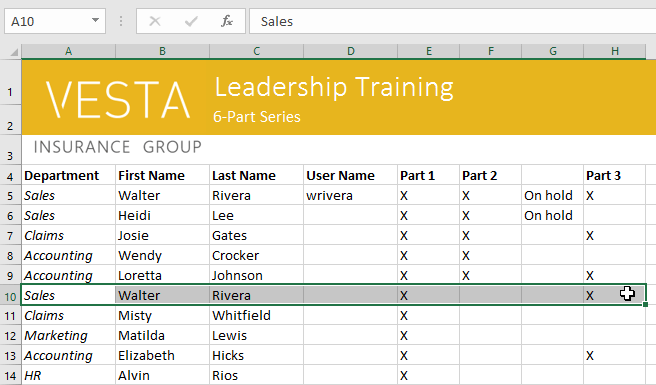
- Select the Clear command on the Home tab, and so click Clear Contents.
- The jail cell contents will be deleted.
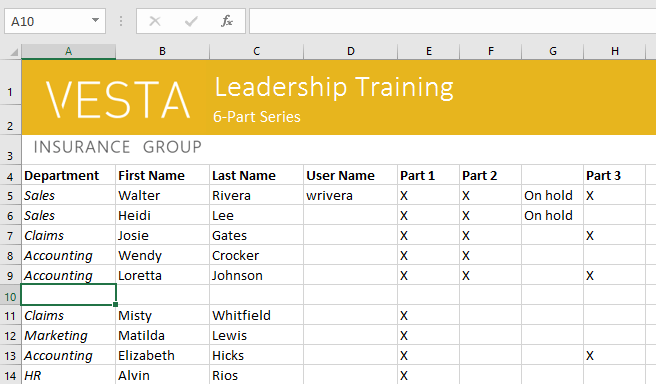
You lot can also use the Delete key on your keyboard to delete content from multiple cells at once. The Backspace key will only delete content from ane cell at a fourth dimension.
To delete cells:
There is an important departure between deleting the content of a cell and deleting the cell itself. If you delete the entire jail cell, the cells beneath it will shift to fill in the gaps and replace the deleted cells.
- Select the cell(s) you want to delete. In our case, nosotros'll select A10:H10.
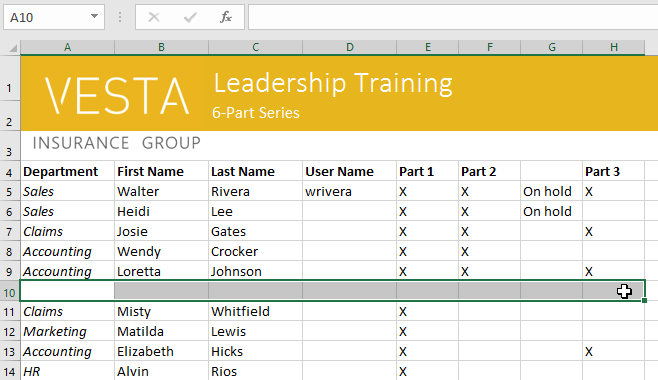
- Select the Delete control from the Dwelling house tab on the Ribbon.
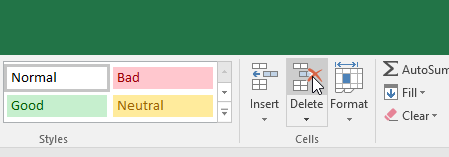
- The cells below volition shift up and fill in the gaps.
To copy and paste cell content:
Excel allows you to copy content that is already entered into your spreadsheet and paste that content to other cells, which can salve you time and endeavor.
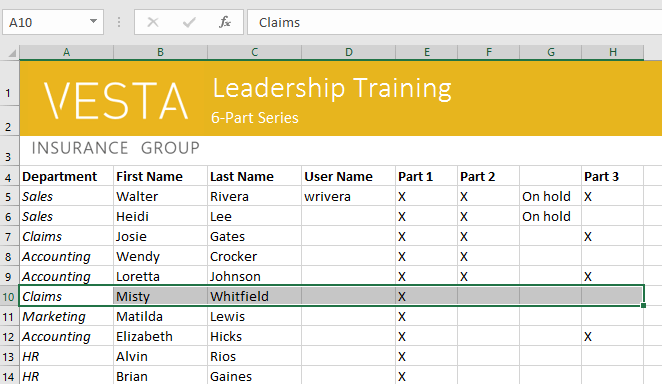
- Select the jail cell(s) yous want to copy. In our example, we'll select F9.
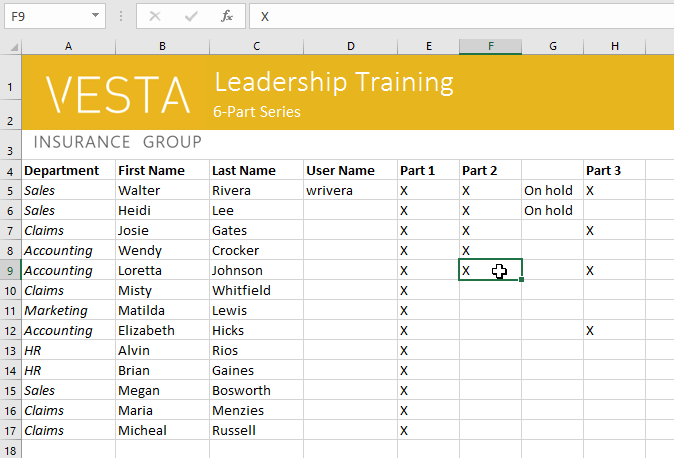
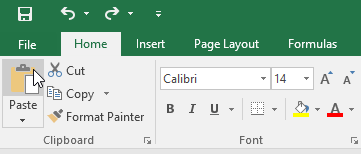
- Click the Copy command on the Dwelling tab, or press Ctrl+C on your keyboard.
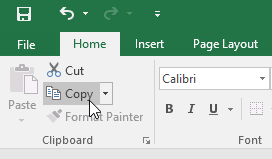
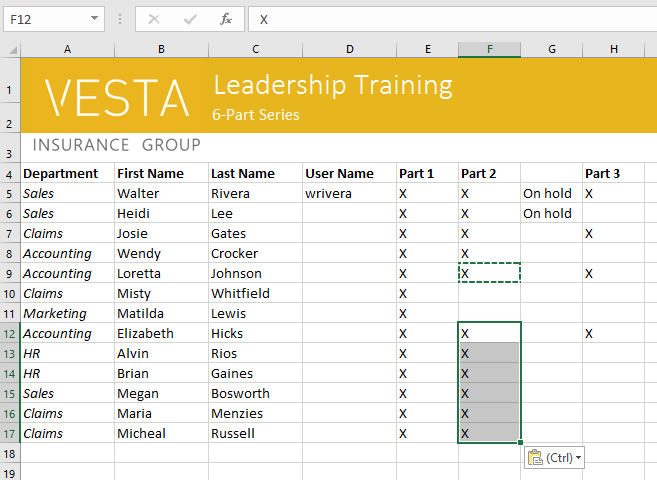
- Select the prison cell(s) where you want to paste the content. In our example, we'll select F12:F17. The copied cell(s) volition accept a dashed box around them.
- Click the Paste command on the Home tab, or printing Ctrl+5 on your keyboard.
- The content will be pasted into the selected cells.
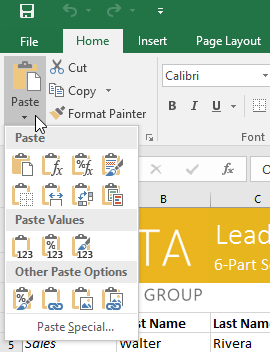
To access more than paste options:
You can also access additional paste options, which are especially convenient when working with cells that contain formulas or formatting. But click the driblet-down pointer on the Paste command to see these options.
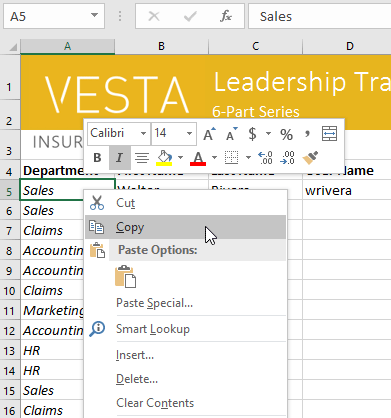
Instead of choosing commands from the Ribbon, you can access commands apace by correct-clicking. Simply select the cell(south) you want to format, then right-click the mouse. A drop-down menu will appear, where you'll find several commands that are also located on the Ribbon.
To cut and paste jail cell content:
Dissimilar copying and pasting, which duplicates cell content, cutting allows you to motility content betwixt cells.
- Select the cell(s) you want to cut. In our example, we'll select G5:G6.
- Right-click the mouse and select the Cutting command. Alternatively, you can use the command on the Home tab, or printing Ctrl+X on your keyboard.
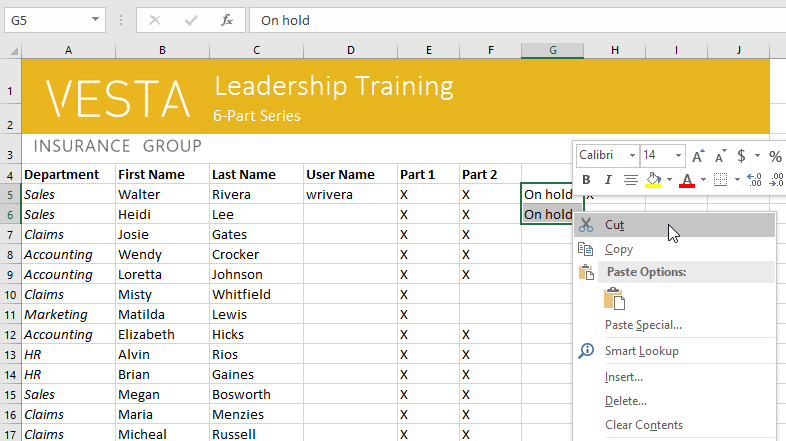
- Select the cells where you want to paste the content. In our example, we'll select F10:F11. The cut cells will now have a dashed box around them.
- Right-click the mouse and select the Paste command. Alternatively, you can employ the command on the Home tab, or press Ctrl+V on your keyboard.
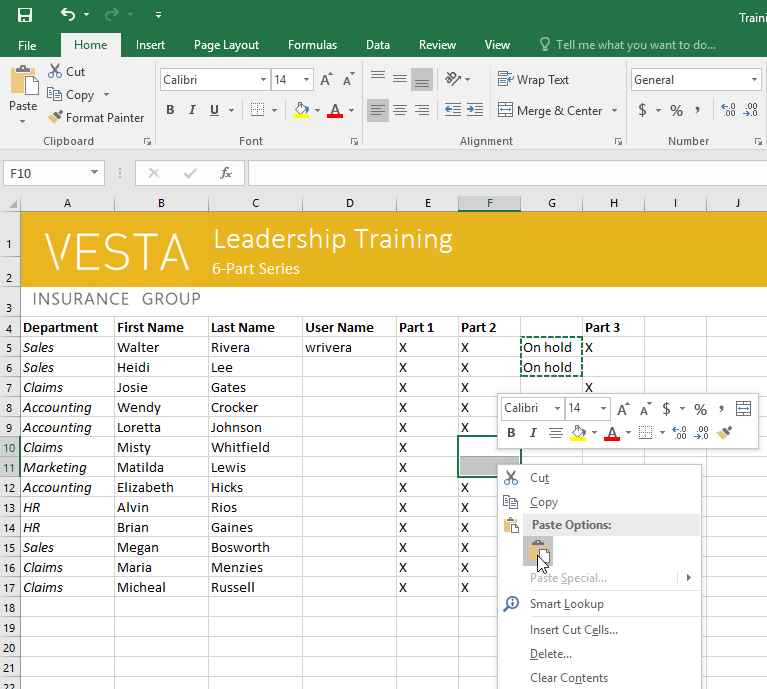
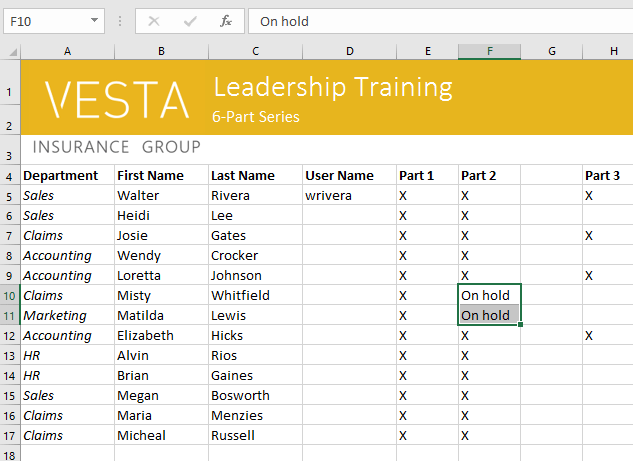
- The cutting content will be removed from the original cells and pasted into the selected cells.
To drag and drop cells:
Instead of cutting, copying, and pasting, y'all can elevate and drop cells to motility their contents.
- Select the cell(southward) you want to movement. In our example, we'll select H4:H12.
- Hover the mouse over the border of the selected cell(s) until the mouse changes to a pointer with four arrows.
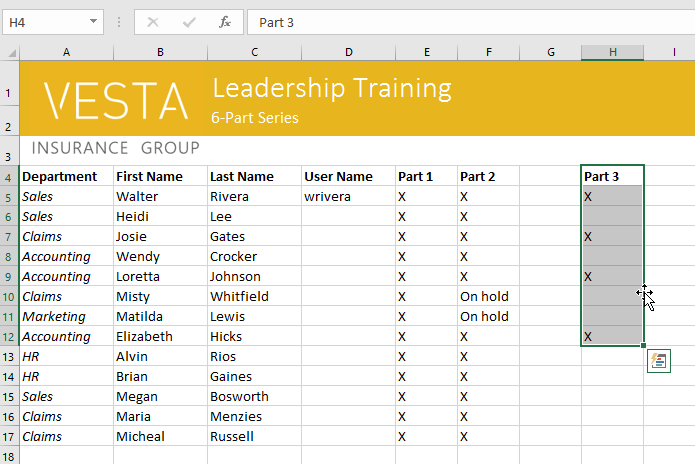
- Click and drag the cells to the desired location. In our example, we'll move them to G4:G12.
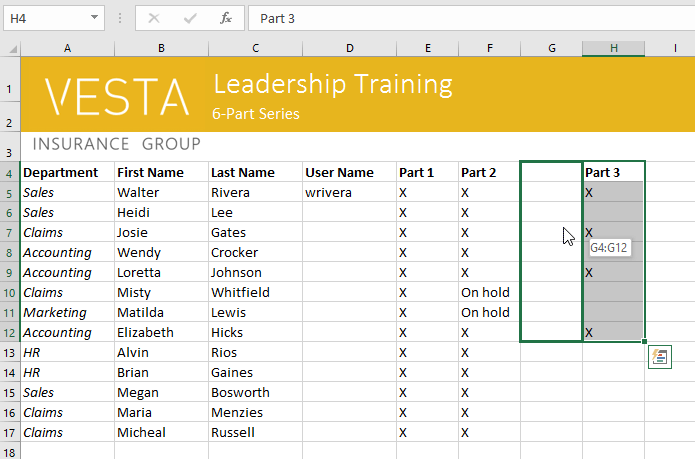
- Release the mouse. The cells will be dropped in the selected location.
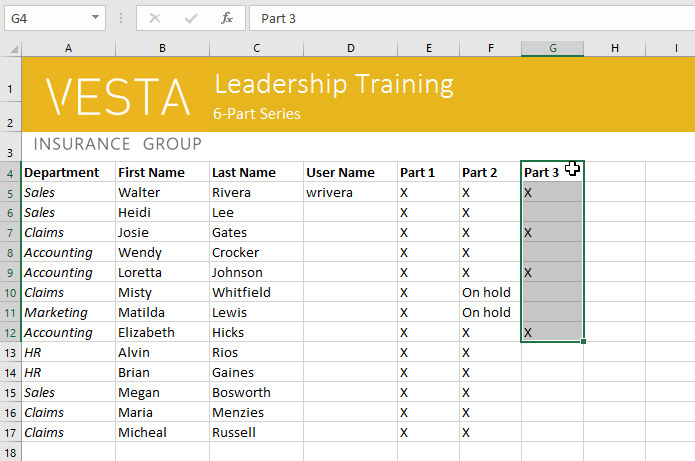
To use the fill handle:
If yous're copying cell content to adjacent cells in the aforementioned row or cavalcade, the fill handle is a practiced alternative to the copy and paste commands.
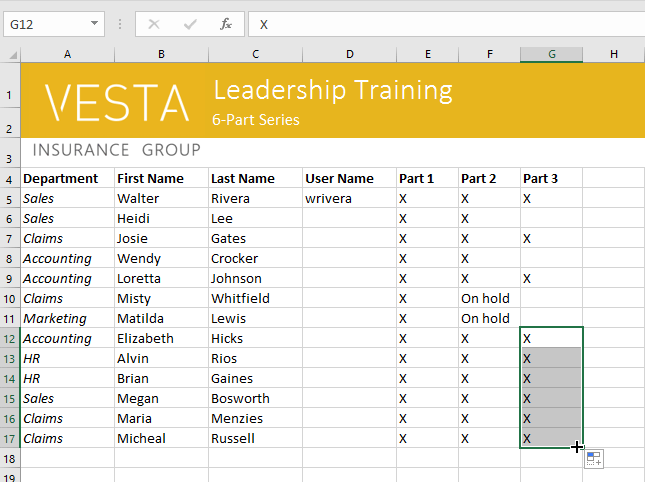
- Select the jail cell(s) containing the content you want to utilise, and so hover the mouse over the lower-right corner of the cell so the fill handle appears.
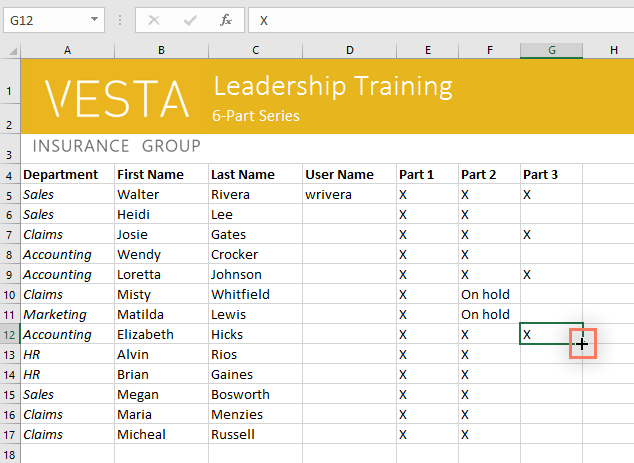
- Click and drag the fill handle until all of the cells you want to fill are selected. In our example, we'll select G13:G17.
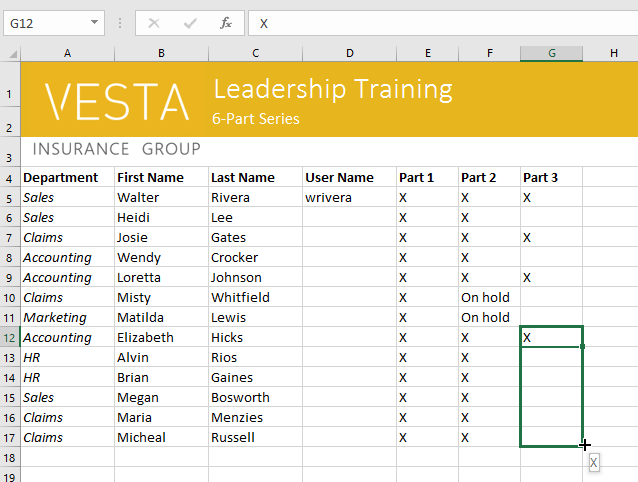
- Release the mouse to fill the selected cells.
To go on a series with the fill handle:
The fill up handle can also be used to continue a series. Whenever the content of a row or column follows a sequential order, like numbers (1, two, 3) or days (Monday, Tuesday, Wednesday), the fill handle can judge what should come next in the series. In most cases, y'all volition demand to select multiple cells before using the fill handle to help Excel determine the serial lodge. Let's take a look at an instance:
- Select the cell range that contains the series you want to continue. In our example, we'll select E4:G4.
- Click and drag the make full handle to go on the series.
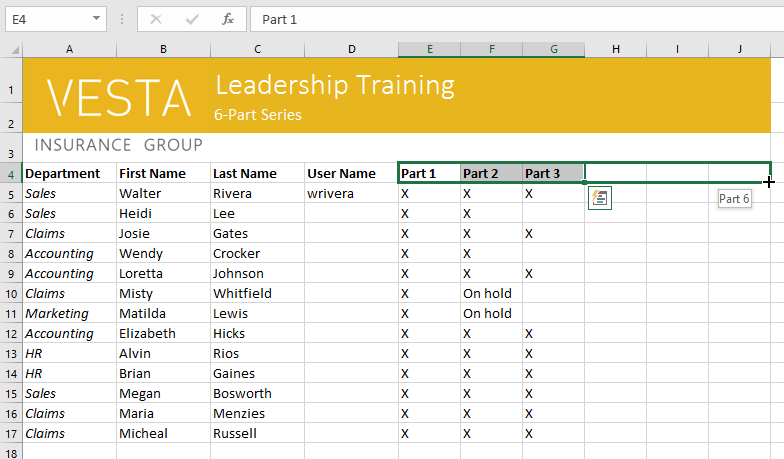
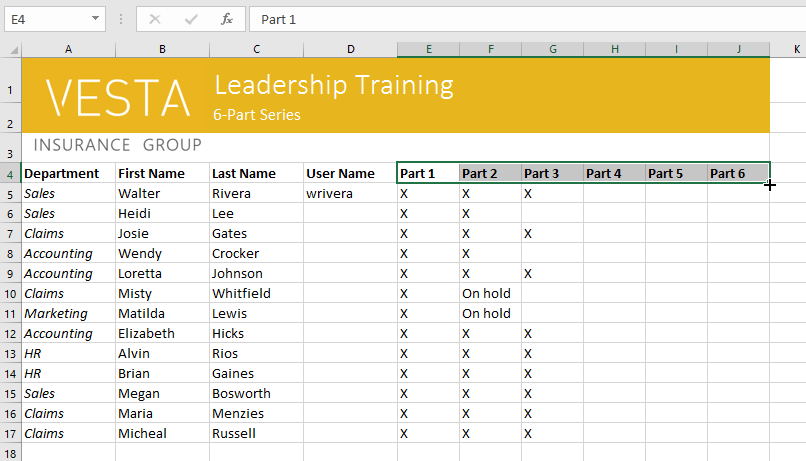
- Release the mouse. If Excel understood the series, information technology will be continued in the selected cells. In our example, Excel added Part 4, Function 5, and Part 6 to H4:J4.
You tin can also double-click the fill handle instead of clicking and dragging. This can be useful with larger spreadsheets, where clicking and dragging may exist awkward.
Sentinel the video beneath to run across an example of double-clicking the fill handle.
Challenge!
- Open up our practice workbook.
- Select cell D6 and type hlee.
- Clear the contents in row 14.
- Delete column G.
- Using either cut and paste or drag and drop, move the contents of row xviii to row fourteen.
- Use the fill handle to put an Ten in cells F9:F17.
- When you lot're finished, your workbook should look like this:

/en/excel2016/modifying-columns-rows-and-cells/content/
Source: https://edu.gcfglobal.org/en/excel2016/cell-basics/1/
0 Response to "You Know a Cell Is Active When ____."
Post a Comment